
The question “How long can my child use a phone?” can no longer be answered with a single number. In January 2026, the American Academy of Pediatrics (AAP) updated its recommendations on digital media and moved away from the idea of one universal limit for every school-age child and teenager. Experts now look not only at duration, but also at content, time of day, a child’s ability to stop, and most importantly, what screen use is replacing.
That does not mean hours no longer matter. For younger children, age-based limits are still fairly strict. But for a child over five, two hours of YouTube before bed, two hours of schoolwork on a laptop, and two hours of video calls with friends are three very different situations. Parents need more than a timer to judge them properly.
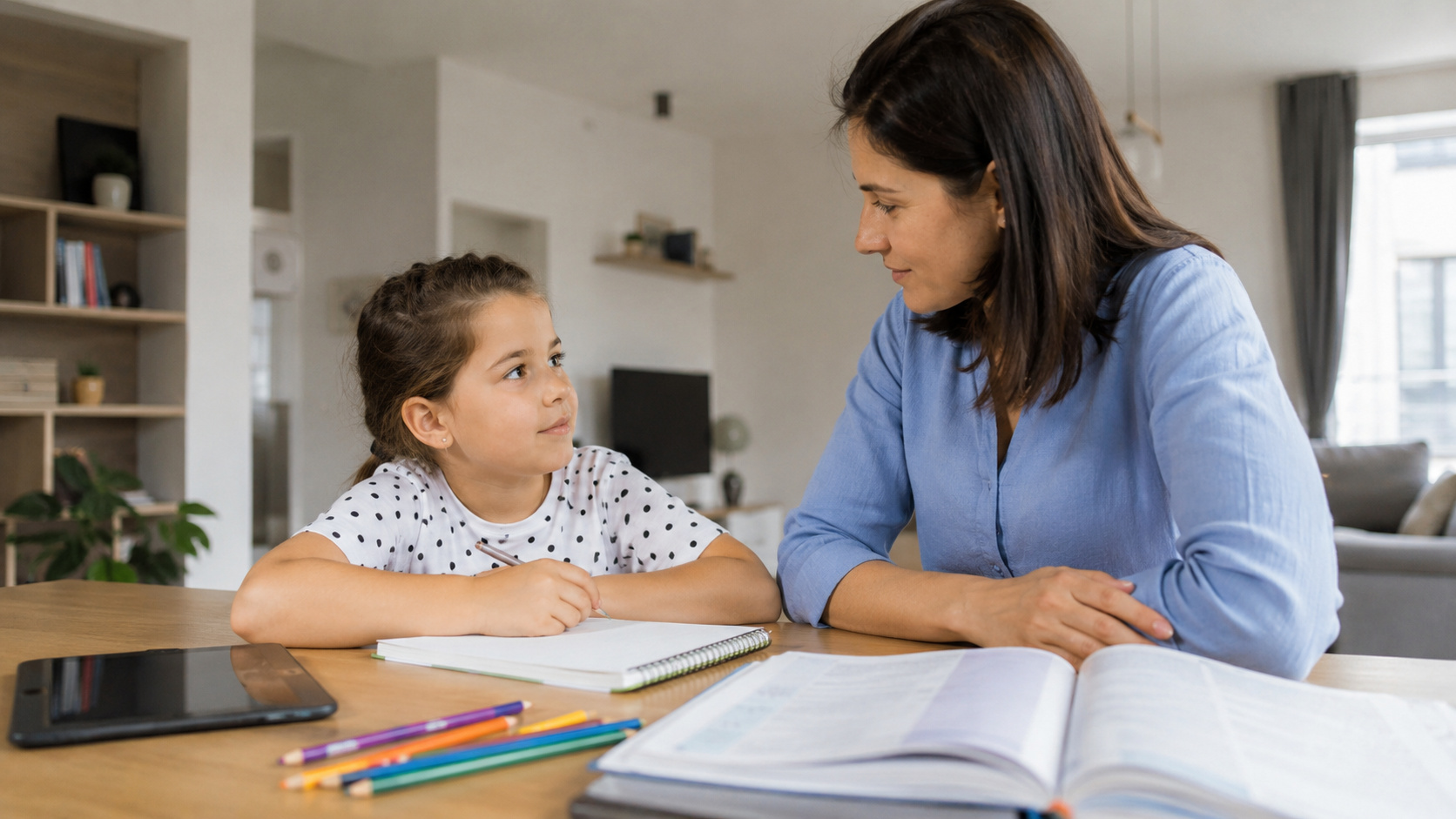
What changed in screen time guidance in 2026
Older discussions about screen time often focused on one figure: the number of hours spent in front of a device. The AAP’s updated policy looks at the digital environment more broadly. It includes not only smartphones and television, but also algorithm-driven feeds, social media, streaming platforms, apps, educational services, and other products that compete for attention in very different ways.
This distinction matters. A service built around autoplay, infinite scrolling, notifications, and personalized recommendations removes many of the natural stopping points that would otherwise help a user put the device down. For children, whose self-control is still developing, ending this kind of session can be objectively harder than closing a video or an app with a clear endpoint.
That is why the AAP does not set a strict rule of “no more than two hours” for every child over five. The 2026 policy takes a more flexible approach: when a family needs a specific limit, a pediatrician can help set one that fits the child’s routine. For some school-age children and teenagers, a practical boundary may be around 1–2 hours of entertainment media a day, or more, as long as digital entertainment does not displace sleep, physical activity, reading, schoolwork, and family time. In other words, 1–2 hours can be an individual target, not a universal medical rule.
How much screen time is appropriate at different ages?
For children under five, the World Health Organization still provides the clearest age-specific benchmarks. For older children, it is more useful to combine AAP media guidance with established recommendations for sleep and physical activity.
| Age | Practical guideline | What matters in practice |
|---|---|---|
| Under 1 year | WHO does not recommend sedentary screen time | Priority should be given to movement, interaction with caregivers, conversation, and exploring the physical world. |
| 1 year | Sedentary screen time is not recommended | A screen should not become the default way to occupy or calm a child. |
| 2 years | No more than 1 hour a day; less is better | Use short sessions, age-appropriate content, and ideally watch or interact together with an adult. |
| 3–4 years | No more than 1 hour a day; less is better | Children still need 10–13 hours of sleep and at least 180 minutes of varied physical activity across the day. |
| 5–12 years | The AAP does not set one universal limit | Children aged 6–12 usually need 9–12 hours of sleep. WHO recommends an average of at least 60 minutes of moderate-to-vigorous physical activity a day for ages 5–17. |
| 13–17 years | Limits should be individualized | Teenagers generally need 8–10 hours of sleep. Nighttime phone use, social media habits, and the ability to stop independently become especially important. |
Schoolwork on a laptop should not automatically be counted in the same way as entertainment videos or social media. The AAP’s suggested limits for older children refer mainly to entertainment media. But that does not mean five hours of online lessons are neutral for the eyes or body. Long periods of close-up work still need breaks, and after studying, children especially need time away from sitting.
How to tell when screen time is actually too much
For school-age children, it is often more useful to start with five checks than to ask whether “three hours is bad.” The first is sleep. If a child regularly delays bedtime because of a phone, wakes up to notifications, or is consistently tired in the morning, the digital routine needs to change regardless of the total shown in the Screen Time report.
The second check is movement. For children and teenagers aged 5–17, WHO recommends an average of at least 60 minutes of moderate-to-vigorous physical activity a day across the week. If free time has shifted almost completely from outdoor play, sports, and active hobbies to screens, the problem is no longer an abstract number of hours — it is the activity that has been displaced.
The third check is the ability to stop. A child may be unhappy when a favorite cartoon is turned off, and that alone is normal. A more concerning pattern is when thoughts about the device dominate free time, requests for the phone become constant, the child repeatedly cannot stop at an agreed point, and ending screen use triggers intense and recurring distress.
The fourth check is the role the screen is playing. If a smartphone becomes the only reliable way to stop boredom, a tantrum, anxiety, or anger, the child gets fewer opportunities to practice other forms of emotional regulation. In longitudinal research involving children aged 3–5, more frequent use of mobile devices to calm a child was associated with poorer emotional self-regulation later on. That does not prove that the phone itself “damages” behavior: children who already struggle to regulate emotions may also be given devices more often. Still, specialists do not recommend turning a screen into a universal calming tool.
The fifth check is how the content itself is designed. Infinite feeds, autoplay, frequent notifications, virtual rewards, and personalized recommendations all increase the chance that a session will last longer than planned. In some families, turning off autoplay and unnecessary notifications may be more effective than arguing every day over an extra fifteen minutes.
What screens actually do to sleep, vision, and learning
A phone in the bedroom is a separate sleep risk
The evidence around sleep is stronger than it is for many other popular claims about screens. The AAP’s 2026 technical report links evening digital media use with later bedtimes, shorter sleep duration, and poorer sleep quality.
The mechanism is not limited to blue light. Light exposure may delay melatonin release, but stimulating content matters too: messaging, emotionally engaging videos, or the urge to watch one more clip can all postpone sleep. A third factor is simple access. A notification can wake a child, and once awake, it is easy to continue using the phone.
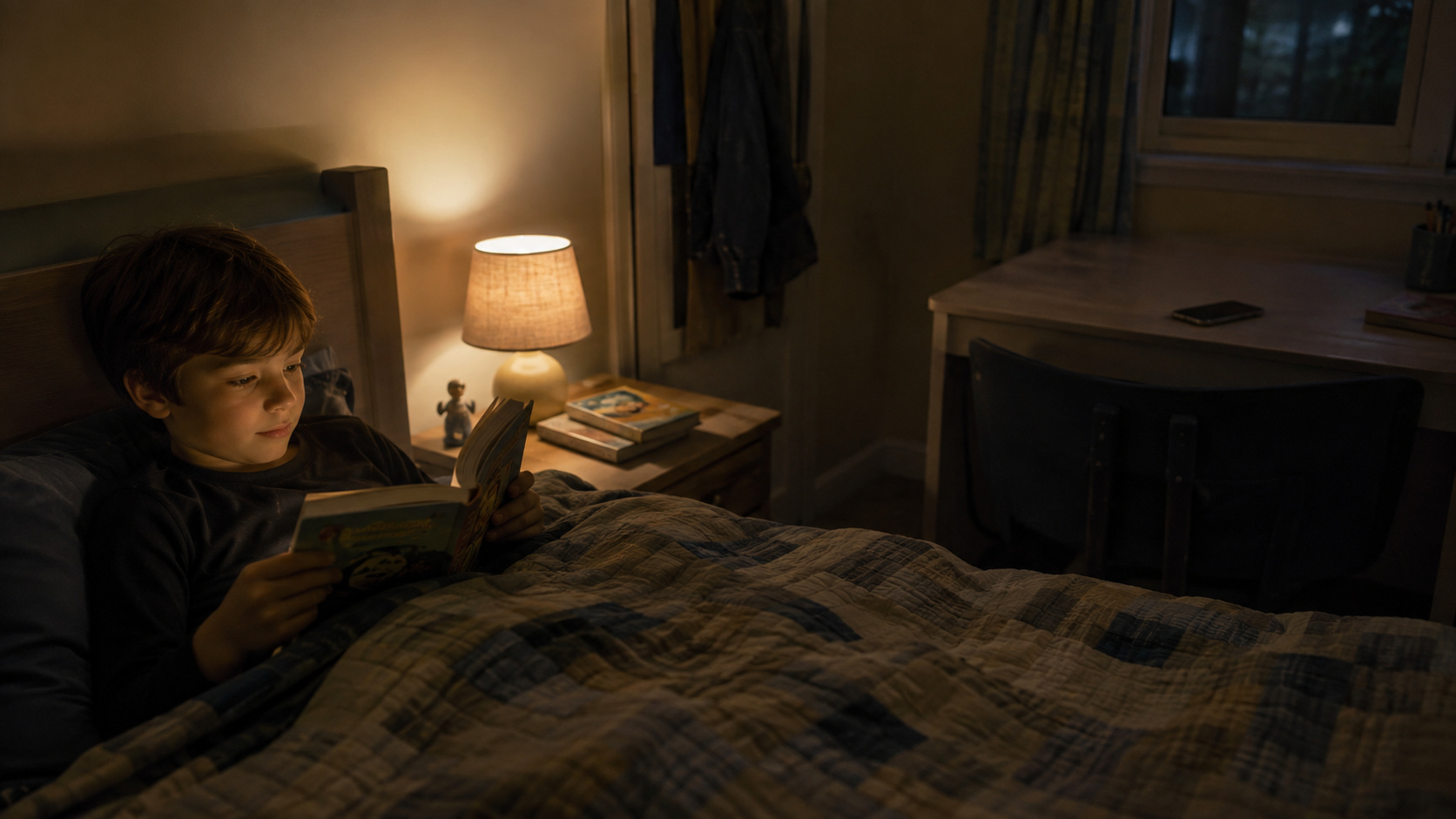
Studies cited by the AAP found poorer sleep outcomes even among teenagers who kept a device in the bedroom without necessarily using it during the night. That is why one of the most practical recommendations is to keep phones and other screens out of the bedroom and stop using them about an hour before sleep. If a phone has to remain in the room, for example because it is used as an alarm, at minimum it should be placed away from the bed with Do Not Disturb enabled.
Night mode does not solve the whole problem. It may reduce part of the light exposure, but it does not remove stimulating content, notifications, or the habit of continuing to scroll.
For the eyes, breaks, viewing distance, and outdoor time matter
The phrase “screens ruin eyesight” is too simplistic. Long periods of close-up viewing can cause eye fatigue, dryness, headaches, and temporary blurred vision. People also blink less when concentrating on a screen, so the eyes dry out faster.
For prolonged screen work, the AAP cites the 20-20-20 rule: about every 20 minutes, look for 20 seconds at something at least 20 feet away, or roughly six meters. Children should also get up and fully step away from the screen for around 10 minutes each hour when possible.
There is also the longer-term issue of myopia. Current evidence links more near work and less outdoor time with the risk of developing nearsightedness, but it is not accurate to say that any smartphone directly causes myopia. Regular outdoor time is considered protective. Special “blue-light glasses” are not routinely necessary for children without a specific indication: there is no convincing evidence that normal blue light from screens damages the eyes.
An educational app is not the same as live teaching
The quality of digital content can produce measurable differences. According to the AAP review, educational programming and co-viewing with an adult can be associated with stronger language skills in children over two. Experimental and quasi-experimental studies of educational apps have also shown benefits for early literacy and mathematics.
But there is an important limitation: even high-quality digital content does not replace interaction with an attentive adult. Infants in particular show what researchers call a transfer deficit — they have more difficulty applying information from a two-dimensional screen to a real-world situation. That is why the word “educational” in an app store is not evidence by itself.
A useful test for preschool content is simple: after watching or using it, can the child apply something outside the screen — name a new object, repeat an action, solve a similar problem, or talk about the story? If an app mainly asks the child to tap bright objects in exchange for animation and rewards, its educational label may be more marketing than substance.
A practical seven-day screen time audit
It is usually better to start with observation rather than an abrupt reduction. For several normal weekdays and one weekend day, note when the child uses a screen, what they are doing, how long each session lasts, and how it ends. A phone’s built-in usage report shows minutes, but not context, so it helps to separate at least three categories: school-related use, intentional entertainment, and unplanned or highly absorbing use.
Next, protect the most sensitive parts of the day. Set a stable bedtime, make the final hour before sleep screen-free, and keep the phone away from the bed or outside the bedroom. Remove unnecessary devices during meals and homework. The AAP also recommends using one screen at a time and turning off the television when no one is intentionally watching it.
Then remove features that artificially extend sessions. Disable autoplay, unnecessary push notifications, and recommendation systems where the service allows it. For younger children, a natural stopping point is often easier to understand than an abstract timer: “one episode” may work better than “ten more minutes.”
The next step is to decide what will fill the space left behind. If a tablet is simply taken away without changing anything else, the child is likely to keep asking for it. For a preschooler, the replacement may be shared play or reading. For a school-age child, it could be outdoor time, building toys, music, or meeting friends. For a teenager, it might be sports, in-person social time, or a personal project. The AAP describes this broader strategy as “crowding in”: instead of focusing only on restriction, families deliberately increase the activities that screens had been pushing out.
After a week, look beyond the total number of hours. Is the child falling asleep earlier? Does the phone appear less often during meals? Is it easier to stop watching? Have outdoor activities or old hobbies returned? If so, the new routine is working even if the total screen-time figure has not dropped dramatically.
When ordinary time limits are not enough
Medical literature uses the term problematic media use for digital behavior that causes meaningful harm to physical, emotional, social, or everyday functioning. It is not defined by one specific number of hours.
Possible signs include persistent preoccupation with digital activity, frequent demands for access to a device, using screens mainly to improve mood, intense negative reactions when use is stopped, and situations in which digital behavior is already interfering with sleep, school, relationships, or other activities. The AAP notes that prevalence estimates vary widely because researchers use different definitions and methods, so it is not appropriate to label every strong interest in a phone as an “addiction.”
Professionals have validated tools for assessment, including the Problematic Media Use Measure and the Problematic and Risky Internet Use Screening Scale. These are fundamentally different from a phone’s built-in hour counter. If parents feel that digital behavior has become unmanageable or is consistently linked to sleep problems, school difficulties, mood changes, or social withdrawal, it makes more sense to discuss the pattern with a pediatrician or another qualified professional than simply to tighten the timer.
A healthy screen routine is visible in what remains off-screen
For young children, age-based limits remain an important benchmark. For school-age children and teenagers, it is more useful to look at the whole day. Are they getting enough sleep for their age? Are they physically active? Can they study without constant notifications? Do they still have offline interests? Can they end a digital activity without the device controlling the next hour of their life?
That is the key shift in the 2026 recommendations. The goal is not to find a magical number of minutes. Parents need to identify where screens provide real value, where they simply fill free time, and where they begin to displace sleep, movement, relationships, and a child’s ability to switch between activities independently.