During a single game, a child does much more than simply make a few moves. They remember the rules, watch what an opponent is doing, decide what can be sacrificed for a future advantage, and change their plan when events do not unfold as expected. Even a simple roll of the dice can create a new challenge: stick with the original plan or quickly look for another option.
Games, however, work in very different ways. In some, the outcome depends almost entirely on the player’s knowledge and decisions. In others, skill is combined with chance, while in some games the result is largely beyond the player’s control. Two games that look similar on the surface can therefore offer very different experiences.
Why games reveal how a child thinks
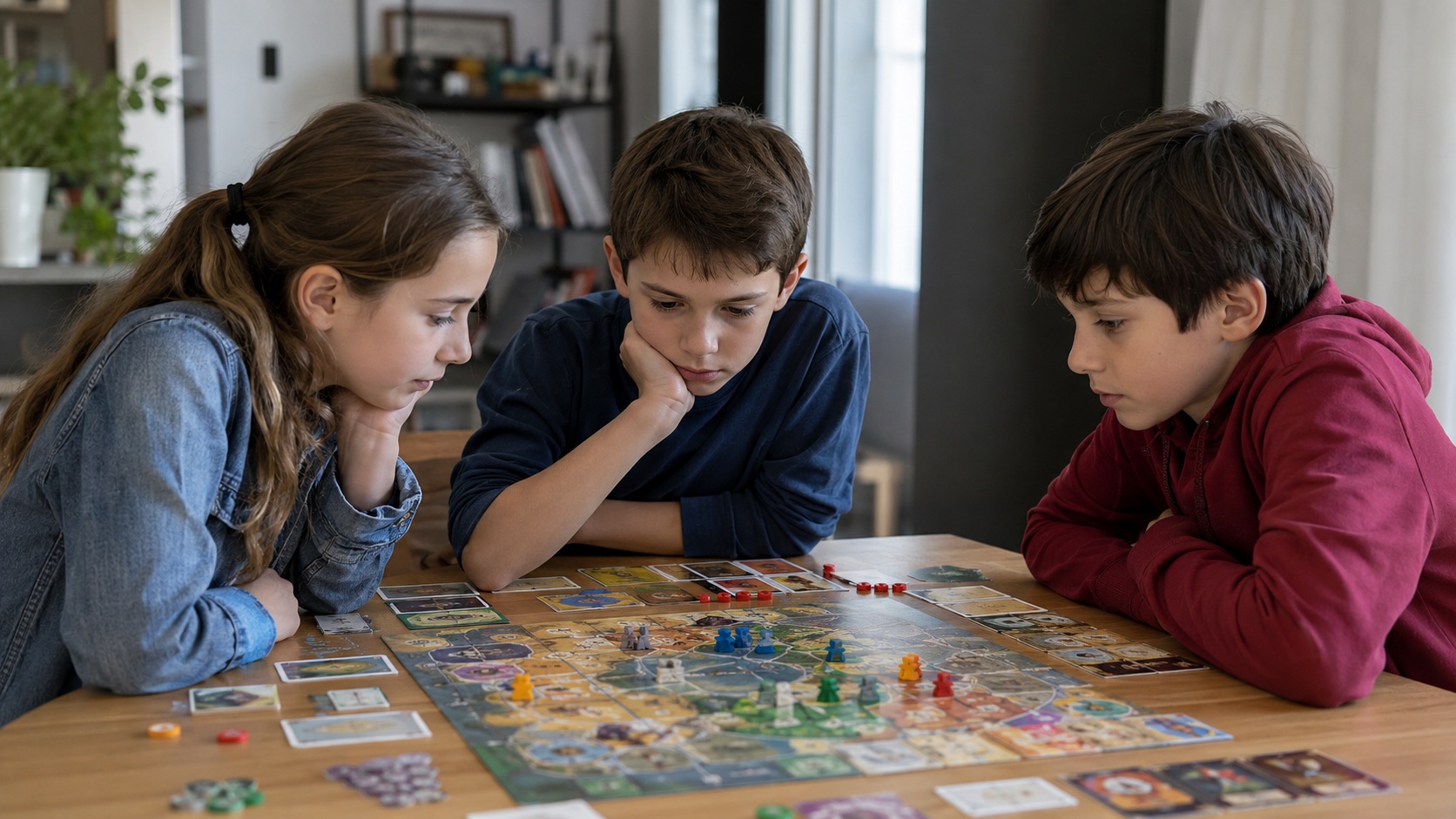
In everyday life, children do not always explain why they made a particular choice. At the gaming table, their way of thinking becomes easier to see. One player makes the first move that seems suitable, another considers several possibilities, while a third closely watches an opponent and tries to understand their plan.
A game constantly presents small decisions and quickly shows their consequences. A poor move can give an opponent an advantage, excessive caution can mean missing the right moment, while changing a plan at the right time can restore a stronger position. A mistake can then be reviewed, and a different approach can be tried in the next game.
It is this repetition that makes games interesting from the point of view of developing thinking skills. A child does not simply learn a rule but applies it under changing conditions. Over time, they begin to notice more details, distinguish what matters from what does not, and act less impulsively.
How skill, strategy and chance differ
The word “game” covers very different mechanics. To understand what kind of challenge a game presents to a child, it helps to look at what primarily determines the outcome:
| Type of game | What influences the outcome | What the player needs to do |
|---|---|---|
| Strategy-based | The player’s own decisions and the opponent’s actions | Plan, compare options and anticipate consequences |
| Strategy with chance | Decisions combined with cards, dice or other random events | Adjust plans and respond to new circumstances |
| Mainly chance-based | A random outcome | Follow the rules and accept a result that is difficult to control |
In a pure strategy game, one strong move creates new opportunities, while a mistake can reduce them. This means that after the game, players can return to a specific moment and understand which decision caused a problem. When chance is added to the rules, the challenge changes: the player has to build a plan while also adapting it to events that could not have been predicted in advance.
That does not make such games less useful. On the contrary, an unexpected event can prevent a child from relying on a memorised pattern and force them to assess the situation again.
What challenges does a child face in a strategy game?
The difficulty of a good strategy game does not come from the number of rules but from the number of meaningful choices it creates. During a single game, a child may need to:
- keep the final goal in mind without being distracted by unhelpful short-term choices;
- remember previous moves and take existing information into account;
- give up a small immediate advantage in favour of a stronger position later;
- anticipate what an opponent may do next;
- change the original plan after an unexpected move;
- continue playing calmly after making a mistake.
But a complicated board game does not automatically provide these benefits. If an adult constantly suggests the best move, the child is effectively following someone else’s strategy. If there are so many rules that half the game is spent checking what is allowed, attention shifts away from solving the problem and towards understanding the mechanics.
A more useful level of difficulty is one where the rules are already clear but the solution is not obvious. That leaves room for the child’s own ideas, mistakes and repeated attempts.
Why games use chance
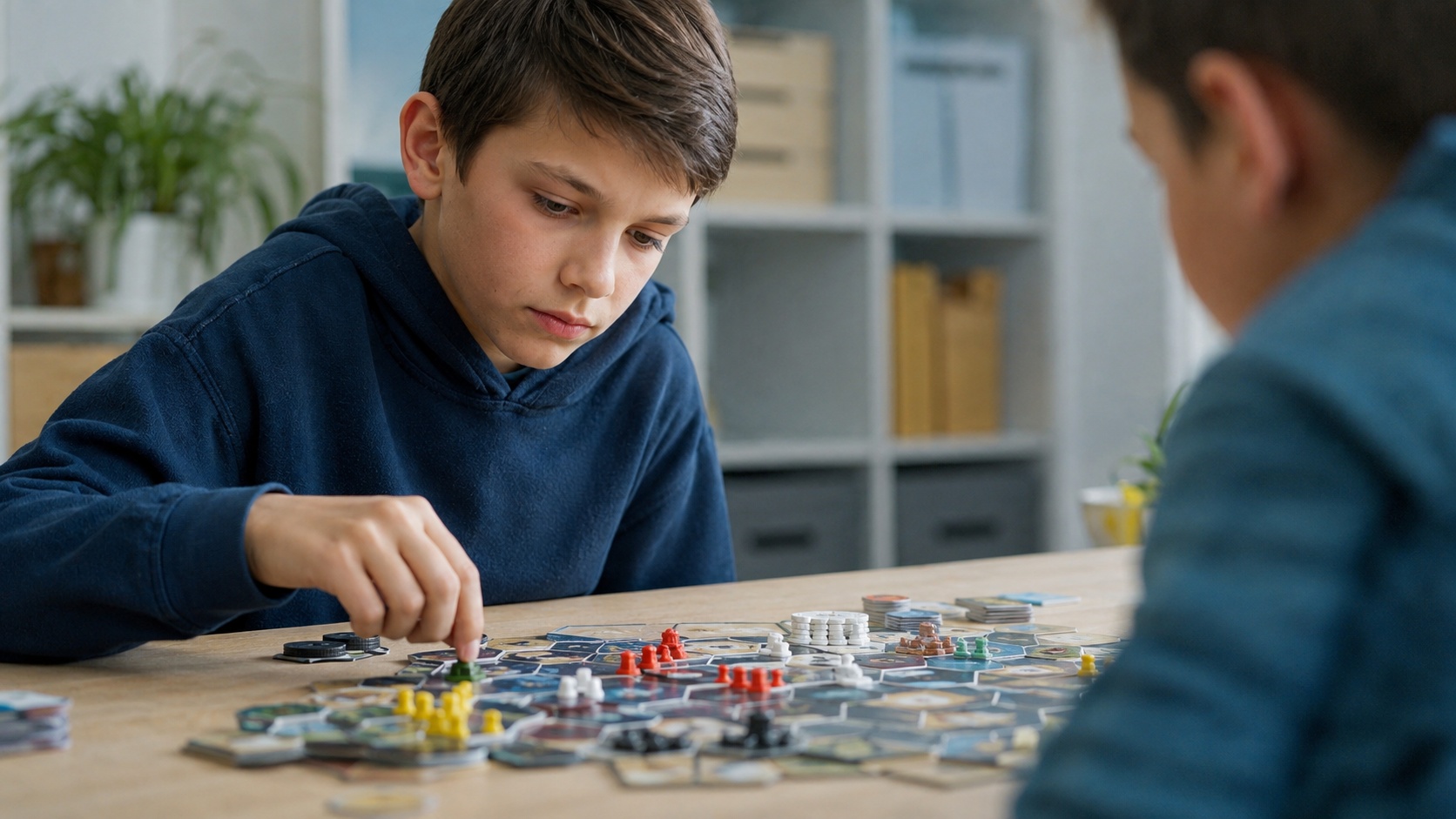
A die roll or a random card does not necessarily get in the way of thinking. It depends on the role chance plays in the game. If a random event only changes the conditions while the next decision remains in the player’s hands, the game can actually become more challenging.
Imagine that a child has spent several turns preparing a particular combination, but a new card suddenly makes it ineffective. Simply continuing with the original plan is no longer enough. The child has to understand what has changed, decide what should be abandoned and identify the opportunities created by the new situation.
This also introduces an important difference between a good decision and a good result. A sensible move can sometimes end badly, while a poorly considered decision may unexpectedly lead to victory. If attention is focused only on the final result, the two situations are easy to confuse.
That is why after a game it can be more useful to ask not only “Who won?” but also “Which move worked best?”, “What did you have to change during the game?” or “What would you do differently next time?”. Questions like these shift attention from the final score to the decision-making process itself.
How to choose a game for a child
The age recommendation on the box is only a rough guide. Two children of the same age can differ greatly in patience, gaming experience and how long they are able to stay focused on one task. It is therefore more useful to pay attention to what happens during play.
If, after a short explanation, a child understands the basic rules and can already choose independently between several possible actions, the difficulty level is probably appropriate. If every move requires help from an adult, it may be better to return to the game later. A game that is too simple can also lose its value quickly: once the best move becomes obvious, there is little left to plan.
There is no need to choose only one type of game. Strategies without random elements clearly demonstrate the connection between a decision and its consequences. Games with cards or dice add the need to adapt. Cooperative formats encourage players to negotiate and find a shared solution. Alternating between these mechanics gives children different kinds of challenges instead of making them repeat the same pattern over and over.
The goal is not greater difficulty, but more interesting thinking
The developmental value of a game does not begin with a long instruction manual or dozens of pieces on the board. It begins when a child notices several possible moves and has to decide which one is better.
That is why a good game can often be recognised not by its complexity, but by the conversation that follows. A child remembers where they took a risk, when they had to abandon the original plan, why the opponent gained an advantage and what they might try differently next time. If those thoughts arise naturally, the game has already done much more than simply fill an evening.