


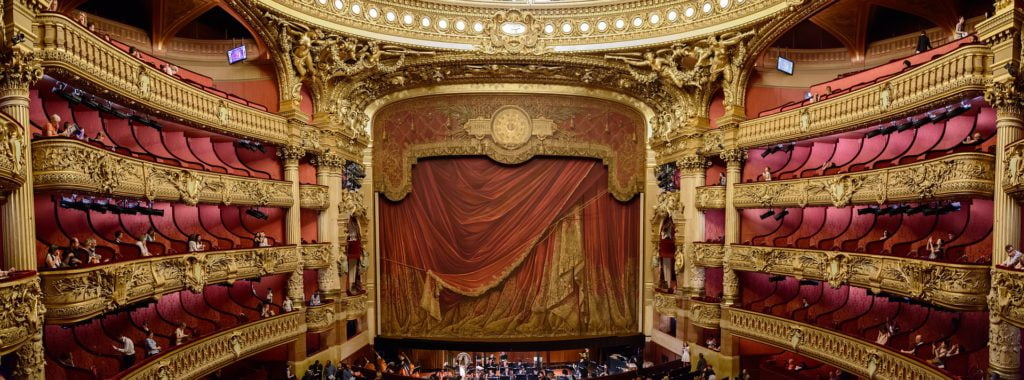
Drama, popularly understood as a performing art, is one of the major modes of representation of fiction. Alternatively, drama is also a genre of visual and written media, used for comparatively serious narrative fiction. However, drama in literature is characterized by a narrative with dialogues and performance. Whether enacted in theatres, radio shows or incorporated into written media, drama is all around us. In this article, let’s learn briefly about the history, significance and different types of drama in literature!

What is Drama?


Etymologically, the word drama comes from the Greek word “draō” which means “to do/ to act”. Have you ever noticed two marks representing drama? These masks identified with drama illustrate the classic conventional distinction between comedy and tragedy.
Drama, to this day, remains a precious art of collaborative production and reception, performed at a theatre for an audience. You might have enjoyed one yourself. However, it wouldn’t be exaggerating to say that this art is slowly fading off. We have neglected the art too much but there’s still time. The importance of theatre art should be inculcated in everyone, whether children or adult.
There are many different forms of drama, including mime, closet drama, improvisations, musicals, opera and others. Some of these forms have found their way into a dramatic literary corpus. For example, a closet drama refers exactly to what was written for reading, not performance. Others are specifically performative drama such as mime. It refers to a theatrical performance of gestures and suggestions of emotions and actions without the use of dialogues.
In simple words, hence, drama in literature is a performance of a narrative with dialogues, performed sometimes with dance and music according to a script. This script in a written form is widely read and enjoyed.
History of Drama in Literature
Ancient Greeks
As you can already guess, we can trace drama straight back to Ancient Greece, where Western drama originated. The cultural city of Athens mainly produced three types of drama- tragedy, comedy and satyr play. The exact origin of drama, or plays is obscure, as is the custom for so many cultural traditions.
However, drama as a mode of celebration was institutionalised in Athens in the 5th century BC through competitions to honour the God Dionysus. From the ancient period, only the works of a few dramatists remain to this day.
Some of them are:
- The tragedians
- Aeschylus,
- Sophocles,
- Euripides
- The comic writers
- Aristophanes
- Menander.
Ancient Romans


Next comes, yes, you guessed it right, Rome!
The Romans came across Greek drama when they captured several territories of the Ancient Greece in the 3rd century BC. By means of the Roman Empire, the art of drama spread far and wide. However, few works survive of the Roman dramatists.
Medieval Period


- In the medieval period, churches took it upon themselves to popularize drama by encouraging enactments of biblical events.
- These types of drama would require two groups to sing in Latin and by the 11th century, this type of drama spread through the whole of Europe and even Russia.
- In the middle ages, plays were generally religious in thematic contexts because they served as important means of disseminating religious codes and education. However, secular and morality plays were also popular.
Elizabethan Period
The 16th and 17th century England was perhaps the most important period for drama. At this time, most plays were written in verses in iambic pentameter. It is a type of metric line used in poetry and verse drama. It specifies the rhythm or meter in a particular line. In addition to William Shakespeare, Christopher Marlowe, Thomas Middleton and Ben Jonson are important playwrights of this period. The themes of such plays were largely drawn from the mythology of Ancient Greece or Roman mythology.


English Restoration Comedies in the period of the 17th and 18th centuries were also popular, bringing on the renaissance of English drama in literature. Stealing from Greeks, Romans and other European counterparts, sexual explicitness, urbane, cosmopolitan wit, current topical literature, and dense, busy storylines marked English Restoration Comedies.
During the second wave of Restoration comedy in the 1690s, William Congreve and John Vanbrugh’s “softer” plays sought to appeal to a more socially diversified audience with a large middle-class element, as well as female viewers.
Modern and Post-Modern Period
Innovative branches of drama led by Norwegian Henrik Ibsen and German Bertolt Brecht marked the 19th and 20th centuries. These plays were marked by realist and modern, experimental themes, social critique. Some important playwrights of this period are George Bernard Shaw, Arthur Miller, Antonin Artaud and others.
Dramatic Expression
Expression of drama, or the language of drama stems from the understanding and context of the text depicted. Different types of drama in literature have different expressions. It can be ritualistic and exaggerated or parallel the motion pictures. Britannica mentions the authors of ancient Greek ceremonial theatre who wrote in verses, and it is thought that their performers delivered this in an incantatory manner midway between speech and song. The result of such rhythmic word delivery was to raise the tone of the entire theatre to that of religious adoration.
A poem accompaniment makes the performers’ highly stylized system of symbolic movements of head and eyes, arms and fingers a harmonic totality in Indian play. The tragic soliloquy in Shakespeare allowed the hero, alone on stage with the audience, to evaluate his thoughts aloud in the persuasive terms of poetry.
What is Drama in Literature?
Drama is strongly linked to literature, so much so that the two are practically inseparable. For an instance, the play Hamlet has both dramatic and literary value.
Drama can reach an audience in two ways
- by way of hearing
- by way of sight.
Consequently, drama is broadly of two types:
- the drama of action
- the drama of literature.
Drama of literature or closet drama
- Dialogues and scenes are written particularly to appeal to the reader.
- In this, dramatists follow the narrative via written performance and build tension around the plot.
- For an instance, let’s take Hamlet. We keep on wondering whether Prince Hamlet will ever revenge his father’s death and free himself of his bothersome ghosts and visions of floating daggers by slaying the play’s antagonist Claudius.
Types of Drama in Literature
There are 7 types of drama in literature to bring out the narrative. These are:
- Comedy
- Farce
- Tragedy
- Tragi-Comedy
- Melodrama
- Opera
- Musical
Let’s look at each of them!


Drama Type – Comedy
Comedy is a type or genre of drama that is intended to make people laugh. However, humour is not the only quality that signifies a comedy. The main themes of a comedy are-
- The tone is lighthearted.
- Ingenious wordplay or twists of phrases.
- Serious issues are addressed in a lighthearted manner.
- Misunderstandings are amusing.
- A happy ending.
- Characters who are silly and out of the ordinary.
- Usually concludes with a wedding, especially in romantic comedies.
The sub-genres of comedy include romantic comedies, sentimental comedies and others. William Shakespeare’s “Much Ado About Nothing” is one of the most famous instances of comedy. With smart banter and more than a few stupid misunderstandings, Beatrice and Benedick go from enemies to lovers. And, as is customary in Shakespearean comedies, it concludes with a wedding!
Another Shakespearean comedy is “A Midsummer Night’s Dream”. This romantic comedy addresses one of his favourite themes, “love conquers all,” with a funny twist. Young couples continually fall in and out of love as a result of a sequence of humorous and surprising events. Their equally humorous real-world problems are magically solved by a mischievous sprite named Puck as they tackle the flaws of love. Old enemies will soon become friends, and truly loved ones will meet again to live happily at Shakespeare’s happy ending.


Farce
Farce is another type of drama in literature which is, broadly humorous, however, there are significant differences between a comedy and a farce. The main themes of farce are-
- Exaggerated wit
- Jokes that are slapstick
- The plot is illogical.
- Unexpected occurrences
- Humor is frequently coarse and inappropriate.
The play “Waiting for Godot” by Samuel Beckett is a case on point. But, The plot revolves around two guys, Vladimir and Estragon. The men wait beneath a tree for Godot, a mystery figure. We do discover, though, that Godot continually sends word that he would arrive the next day, but this never happens. In other words, nothing happens with any surety in this drama.


Drama Type – Tragedy
Therefore, tragedies are one of the most common and popular types of drama. As you can probably guess, tragedies tend to be sad. However, there is more to tragedies than that. The main themes are-
- A fatal fault in the protagonist
- Situations that easily spiral out of control — and not in a good way
- Human agony, hate, or poverty are frequent topics. These are darker topics than in a melodrama.
- Describes the demise of a once heroic or well-liked persona.
- An unredeemable conclusion in which one or more characters die
- Arrives at a terrible catharsis
Shakespeare offers a plethora of tragedies from which to pick. Few, however, can compare to “Othello” in terms of its vicious villain, tragic demise of its hero, and heartbreaking denouement. Because he doesn’t believe he deserves the life he has, Othello loses everything he has ever loved or desired.
![Types of Drama in English Literature [Examples] | Forms of Drama in English Literature](/media/vi/TN0qEkP-pvY/hqdefault.jpg)
Tragi-Comedy
These complex among the types of drama in literature. They are more than just tragedy and comedy blended together. The main themes are-
- A serious plot delivered in a funny, sarcastic, or snarky manner.
- Characters with tragic flaws whose acts do not result in death
- A confusing subject
- Characters with broad personalities that act in stereotypically humorous ways
- There is no joyful or funny conclusion.
Classic plays were primarily concerned with clear-cut comedy, tragedy, or melodramatic genres. Tennessee Williams’ “A Streetcar Named Desire” contains enough comedic aspects to keep it from being classified as a tragedy – yet no one can argue that Blanche DuBois is anything other than a terribly broken character. It is the epitome of modern tragicomedy.
Drama Type – Melodrama
Melodramas are an exaggerated kind of drama in literature, in which conventional one-dimensional characters such as heroes, heroines, and villains contend with exciting, passionate, and frequently deadly situations. The main themes of melodrama are-
- Character clichés include heroes, heroines, villains, mentors, and so on.
- Romantic or sombre stories with sweeping arcs
- Plots and events that are larger-than-life (or very small stories told in big ways)
- Character reactions are exaggerated
- Clearly defined literary topics
- Character flaws must be overcome in order to attain a resolution
- Ending that is sometimes cheerful and sometimes sad
When referring to melodrama, take Henrik Ibsen’s “A Doll’s House”. Nora’s exaggerated emotions place the piece squarely in the category of melodrama. WOW!! The finale is a blend of Nora’s delight and hope and Torvald’s melancholy and despair. Sometimes called “tear-jerkers”, another example of such melodramas is the play “The Glass Menagerie” by Tennessee Williams.
Opera
Many a time, people don’t understand the difference between opera and musicals. An opera is a type of drama where the actors sing the lines or dialogues instead of speaking them. Also, the main themes of an opera are-
- Arias, which are actually musical soliloquies.
- Plot-driving sequences that may or may not be melodious
- A libretto (text) that has been turned to music.
- Tragic, comic, or melodramatic subject matter
- May have a dancing aspect, but mostly depends upon vocal performances
- Set design, costume design, and production
Giacomo Puccini’s “La Boheme” is one of the most famous operas of all time. It portrays the sad narrative of Rodolfo and Mimi, as well as the world of French Bohemia. The drama unfolds over the course of a year, set to one of opera’s most unforgettable compositions.
Drama Type – Musical
Musicals are different from opera. While lines in opera are sung, dialogues in musicals are infused with music and performances. The main themes of musicals are-
- Firstly Songs break up periods of conventional plot.
- Characters frequently sing in unison to express their emotions.
- Songs as plot-altering devices
- Storylines that be dramatic or hilarious
- A memorable and unique musical score
- Frequently a lot of singing and dancing.
Many musicals, such as “Les Miserables” and “Phantom of the Opera” are based on larger literary works. Both of these musical dramas communicate their topics directly via song and use musical sequences to advance the story. They simplify their original material by focusing on the most vital characters and plot components.
Interesting Facts About Greek Drama and Theater
- The term “theatre” is derived from the Greek word “theatron,” which means “seeing place.”
- The masks allowed a single actor to play multiple roles in the same play.
- The skene was a structure behind the orchestra. The skene was where actors changed their costumes. To create the background, pictures were sometimes hung from the skene. This is the origin of the term “scene.”
- The chorus would occasionally comment on the characters in the play or warn the hero of impending danger.
- A man named Thespis was the first actor. Actors are sometimes referred to as “Thespians” nowadays.
- Ancient Greece is where the drama masks that have come to symbolise theatre first appeared. The two masks represent the two main genres of Greek theatre, Comedy and Tragedy.
- In ancient Greece, tragedy, a genre that focuses on human suffering, was the most popular theatrical form. Thespis, a playwright and actor, is credited with the first performance of tragedy at the Dionysia.
Parting Thoughts
Drama in literature is an ancient art, that we should preserve. Not only is it enjoyable to read, but also is delightful to perform. However, Theatre is a very subtle art form, and these actors deserve our respect and reverence. Also, Immerse yourself in reading more and more drama to enjoy this ancient art.
Drama allows children to explore, discuss, and deal with difficult issues, as well as express their emotions in a safe environment. It allows them to investigate their own cultural values as well as those of others, both past and present.
For more such informative and exciting articles keep visiting our blog!
FAQs
A drama is a form of literature that is created to be performed in front of an audience. This sort of writing takes the form of a script, and the tale is told through the lines of the actors who play the characters. People can view dramas on stage, on the radio, or on film.
Here are three famous examples of drama in literature:
1. A tragedy is depicted in William Shakespeare’s famous play Romeo and Juliet. Due to their bickering families, two young children in this drama fall in love and feel compelled to keep their feelings hidden from their parents. Their hasty decisions, however, lead to their deaths.
2. Jean Cocteau’s play Les parents terribles is an example of a melodrama that has numerous layers of overdramatic scenarios such as infidelity and suicide.
3. The Phantom of the Opera by Andrew Lloyd Weber is a well-known example of a musical play that portrays the story of obsession.
Dramas serve the purpose of entertaining the audience. While reading a narrative might be powerful, seeing it performed by actors adds a sense of realism to the work. Many individuals prefer spending their spare time watching dramas, specifically in the form of movies or television, in this day and age of binge-watching.
Tragedy, comedy, tragicomedy, and melodrama are the four main types of drama. Although these genres emerged at separate times, each has its own distinct qualities. All of them, however, play important roles in contemporary culture and should be recognised.


